Edge AI Explained: Running AI Directly On Your Device
admin
2 months ago
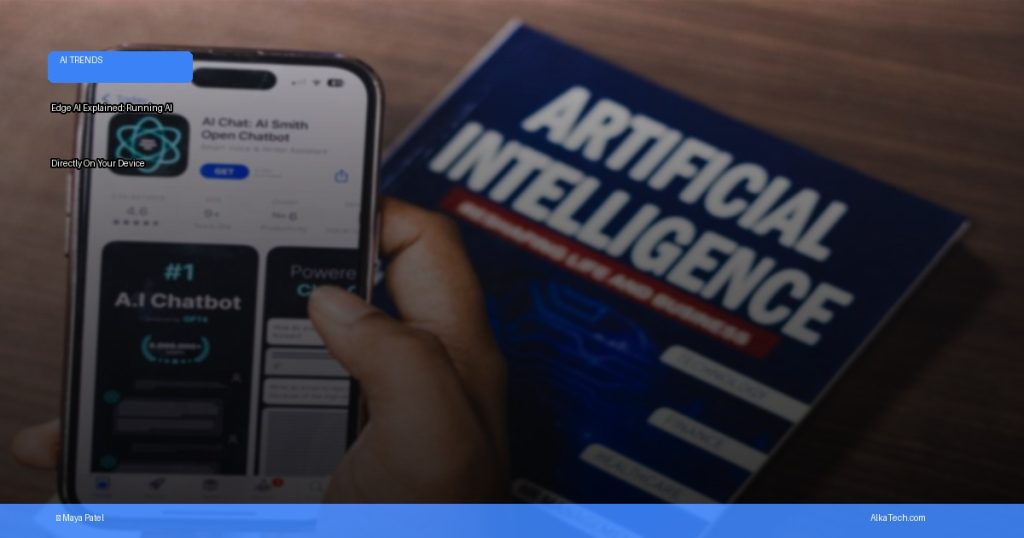
In the world of artificial intelligence, our minds often conjure images of vast data centers, powerful cloud servers processing petabytes of information, and complex algorithms running miles away from us. But what if the intelligence could reside right in your pocket, on your smart speaker, or even in your car? This is precisely the premise behind Edge AI, a revolutionary approach that brings AI capabilities directly to the device where data is generated. Today, we’re diving deep into what Edge AI explained truly means for the future of technology and our daily lives.
📋 Table of Contents
Edge AI, sometimes referred to as on-device AI, represents a significant paradigm shift from traditional cloud-based AI. Instead of sending all data to a centralized cloud for processing, AI models run locally on the “edge” – the devices themselves. This could be anything from your smartphone, a smart camera, an industrial sensor, or even a self-driving car. The intelligence, rather than being a distant entity, becomes an integral part of the device’s functionality, making it smarter, faster, and more private. (See also: Clean Up Your Smartphone: Double Battery Life & Boost Speed)
Understanding Edge AI Explained: Why It Matters
The move towards running artificial intelligence on your device isn’t just a technical curiosity; it addresses several critical limitations of cloud-centric AI. Here’s why Edge AI is rapidly gaining traction:
- Reduced Latency: When AI models run on the cloud, data must travel to the data center, be processed, and then the results sent back. This round trip can introduce noticeable delays, especially for real-time applications. Edge AI eliminates this travel time, allowing for instantaneous responses. Imagine an autonomous vehicle needing to make a split-second decision; cloud latency simply isn’t an option.
- Enhanced Privacy and Security: Transmitting sensitive data over networks to the cloud inherently carries privacy and security risks. With Edge AI, personal or proprietary data can be processed and analyzed locally, often without ever leaving the device. This significantly reduces the attack surface and helps comply with stringent data privacy regulations like GDPR.
- Lower Bandwidth Consumption: Sending vast amounts of raw data (e.g., continuous video feeds from thousands of cameras) to the cloud is incredibly bandwidth-intensive and costly. Edge AI allows devices to process data locally and only send relevant insights or aggregated results to the cloud, drastically cutting down on network traffic.
- Increased Reliability: Cloud connectivity isn’t always guaranteed. Edge AI devices can operate autonomously even when internet access is intermittent or completely unavailable. This is crucial for critical applications in remote areas, disaster zones, or environments where continuous uptime is paramount.
- Cost-Effectiveness: While initial hardware costs for edge devices might be higher, the long-term savings on cloud computing resources, data storage, and network bandwidth can be substantial, especially for large-scale deployments.
The Mechanics of On-Device AI
So, how do complex AI models, often trained on massive datasets using powerful cloud GPUs, get squeezed onto resource-constrained edge devices? It involves several key techniques:
- Model Optimization and Compression: Large AI models are often “pruned,” “quantized,” or “distilled” to reduce their size and computational requirements without significantly sacrificing accuracy. This makes them suitable for smaller memory footprints and lower processing power.
- Specialized Hardware: The proliferation of dedicated AI accelerators, known as Neural Processing Units (NPUs) or AI chips, within smartphones, IoT devices, and embedded systems is a game-changer. These chips are specifically designed to efficiently execute AI inferences with high performance and low power consumption.
- Efficient Frameworks: Lightweight AI frameworks and runtimes optimized for edge deployment (e.g., TensorFlow Lite, PyTorch Mobile) enable developers to deploy models effectively on diverse hardware.
Applications of Edge AI Explained: Real-World Impact
The implications of Edge AI are vast and already shaping various industries:
- Smartphones: Many features we take for granted, like facial recognition (Face ID), computational photography (portrait mode, night mode), real-time language translation, and personalized voice assistants, are powered by on-device AI. Your phone processes these tasks locally, keeping your data private and interactions swift.
- IoT Devices and Smart Homes: Smart cameras can analyze video feeds locally to detect intruders or specific events, sending alerts only when necessary. Smart thermostats learn patterns and adjust settings without constant cloud communication. Industrial sensors can monitor machinery for anomalies in real-time, predicting maintenance needs before failures occur. This is where edge computing truly shines.
- Autonomous Vehicles: Self-driving cars rely heavily on Edge AI. They must process vast amounts of sensor data (cameras, radar, lidar) instantly to navigate, detect obstacles, and make critical driving decisions. There’s no time for cloud round trips when safety is at stake.
- Healthcare: Wearable devices can monitor vital signs, detect irregularities, and provide immediate feedback or alerts, all while processing sensitive health data on the device itself. Portable diagnostic tools can analyze medical images locally, aiding rapid diagnosis in remote areas.
- Retail: Edge AI can enhance in-store experiences through intelligent inventory management, personalized recommendations, and anonymous customer flow analysis, improving efficiency and reducing reliance on central servers.
The Future: Towards Decentralized AI
Edge AI is a crucial step towards a more distributed and intelligent future. It paves the way for truly decentralized AI systems where intelligence is not just on the device, but potentially shared and learned across a network of devices without a central authority. This concept, often intertwined with federated learning, allows multiple edge devices to collaboratively train a shared AI model while keeping their raw data local, further enhancing privacy and robustness.
While challenges remain—such as managing model updates across thousands of devices, ensuring consistent performance on varying hardware, and addressing potential security vulnerabilities inherent in a distributed system—the momentum behind Edge AI is undeniable. The advancements in AI model compression, specialized hardware, and efficient software frameworks are continuously pushing the boundaries of what’s possible. (See also: Autonomous Agents, ML Algorithms & AI Trends: KDnuggets Weekly Roundup)
Edge AI is not just a technological trend; it’s a fundamental re-architecture of how artificial intelligence interacts with the physical world. By bringing powerful analytical capabilities closer to the source of data, it promises a future of more responsive, private, reliable, and efficient intelligent systems. As a tech journalist passionate about emerging technologies, I believe Edge AI is set to redefine our interaction with smart devices, making our world not just connected, but truly intelligent, right where we are.
❓ Frequently Asked Questions
What is Edge AI?
Edge AI involves processing artificial intelligence tasks directly on a local device, rather than sending data to a central cloud server for computation.
How does Edge AI differ from cloud AI?
Unlike cloud AI, which relies on remote servers, Edge AI performs computations locally, offering faster response times, enhanced data privacy, and offline functionality.
What are the main benefits of Edge AI?
Key benefits include reduced latency, improved data privacy, lower bandwidth usage, enhanced security, and the ability to operate without constant internet connectivity.
Can you give examples of Edge AI in action?
Examples include smart cameras with on-device object detection, voice assistants processing commands locally, autonomous vehicles, and industrial IoT sensors for real-time analysis.



Leave a Reply